
Finding Manufacturing Subcontractors in Asia for European Companies
- October 5, 2026
- Posted by: marketing
- Categories: Manufacturing, Uncategorized
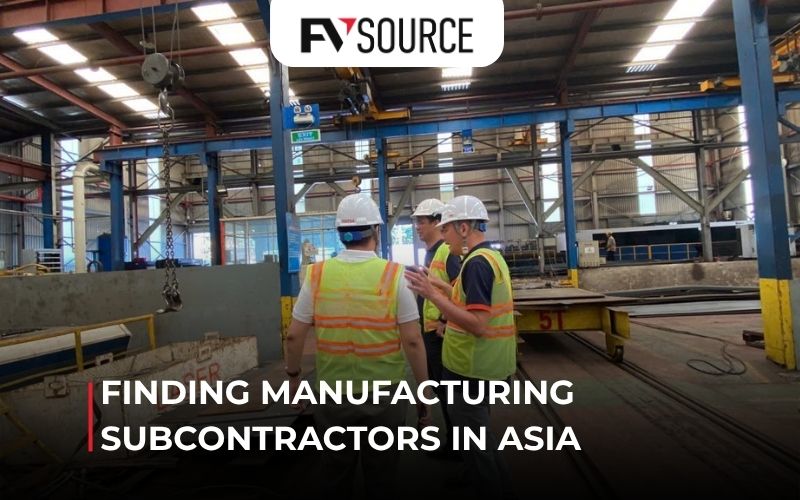
For European companies, working with a manufacturing subcontractor in Asia can provide access to additional production capacity, specialized capabilities, and competitive manufacturing costs without requiring an investment in a new facility. Yet finding a factory that can consistently meet European expectations involves more than searching through supplier directories or comparing quotations.
The real challenge is identifying a subcontractor that fits the product, production requirements, quality expectations, and way of working of the buyer. A factory may offer an attractive price and impressive equipment, but that does not necessarily mean it is the right production partner.
A structured approach helps European buyers move from a large pool of potential suppliers to a shortlist of manufacturers that have been properly evaluated and verified.
1. What Is Changing in Vietnam’s FDI Priorities?
Vietnam’s earlier FDI strategy helped establish the country as a competitive manufacturing base. Processing and manufacturing continue to account for a large share of new FDI. In the first four months of 2026, the sector attracted US$8.12 billion, accounting for 66.8% of total newly registered FDI.
However, Vietnam’s next stage of development requires more than capital and production capacity.
Resolution 10 identifies several areas that need improvement, including the relatively high share of labor-, resource-, land-, and energy-intensive projects, as well as processing and assembly activities. It also points to relatively low localization and domestic value added, limited connections between foreign-invested and domestic companies, and insufficient technology transfer.
This does not mean Vietnam is moving away from manufacturing or becoming less open to foreign investors. Instead, the policy direction places greater emphasis on the quality, efficiency, and longer-term contribution of investment.
The question is increasingly not only how much capital a project brings, but also what capabilities, technology, skills, and local economic links it can develop in Vietnam.
For foreign companies, understanding this shift is only one part of evaluating an investment opportunity. Choosing the right market entry structure, understanding regulatory requirements, and assessing the practical challenges of operating in Vietnam are equally important considerations.
>>> On September 24, 2026, FVSource hosted the “Beyond China Plus One” webinar for foreign companies looking to find factories, source suppliers, and set up manufacturing operations in Vietnam and Southeast Asia. Moderated by CEO Guillaume Rondan, the session featured Kim Nguyen (Strategic Partner in Germany) and Pietro Karjalainen (CSO & Co-Founder), who shared their perspectives on the region’s changing industrial landscape.
The discussion went beyond the usual focus on low labor costs, highlighting the importance of assessing local industrial capabilities, total landed costs, and potential risks when choosing a manufacturing location. The speakers also shared practical approaches to evaluating and qualifying local partners, helping companies build more resilient and sustainable supply chains over the long term.
2. Define Your Requirements Before Searching
A common mistake is to start looking for factories before clearly defining what the subcontractor needs to deliver. This often leads to a long list of suppliers that appear suitable but are difficult to compare because each one is being evaluated against different assumptions.
The first step should be to establish the technical and commercial requirements.
These may include:
- Product specifications, drawings, materials, and tolerances
- Required manufacturing processes and equipment
- Expected annual or monthly production volume
- Target lead times
- Quality standards and certifications
- Packaging and labeling requirements
- Minimum order quantities
- Target cost or pricing expectations
- Export and logistics requirements
The level of detail will depend on the product. A buyer sourcing a standardized component may only need a relatively straightforward specification package. For engineered products, however, the manufacturer may need detailed drawings, material specifications, testing requirements, and quality documentation before it can provide a meaningful quotation.
It is also useful to distinguish between requirements that are non-negotiable and those that can be discussed. For example, a specific certification may be mandatory, while packaging format or order volume may be open to negotiation.
This distinction makes the search more efficient. Instead of asking, “Which factory can produce this product?”, the buyer can ask a more useful question: “Which subcontractors meet the requirements that matter most to our production?”
3. Where to Find Manufacturing Subcontractors in Asia
Once the requirements are clear, European companies can begin building a supplier pool. No single sourcing channel is sufficient for every industry, so it is often useful to combine several approaches.
Industry networks and trade associations
Industry associations can provide access to manufacturers that are already active in a particular sector. Local business networks, chambers of commerce, and trade organizations can also help buyers identify companies that may not have a strong presence on international B2B platforms.
This route can be particularly useful for specialized or industrial products, where technical capabilities matter more than online visibility.
Manufacturing exhibitions and sourcing events
Trade fairs provide an opportunity to meet manufacturers directly and understand their capabilities through conversations, product samples, and demonstrations. They can also reveal how a supplier presents itself to international buyers.
For European companies entering an unfamiliar Asian market, exhibitions can be an efficient way to build an initial longlist within a relatively short period.
Online supplier platforms and directories
Online B2B platforms make it easier to identify manufacturers by product category, location, production process, and certification. They are useful for market mapping, but supplier profiles should be treated as an initial source of information rather than proof of manufacturing capability.
A polished profile does not demonstrate how a factory performs during actual production.
Local sourcing partners
For companies without an established presence in Asia, local sourcing specialists can help identify manufacturers, communicate requirements, conduct factory visits, and coordinate verification.
Their value often lies in local knowledge. They may understand which manufacturers actually perform certain processes in-house, which factories rely heavily on subcontracting, and how local business practices can affect production.
The objective at this stage is not to select a supplier immediately. It is to build a qualified longlist that can be assessed using the same criteria.
4. How to Screen Potential Subcontractors
After identifying potential suppliers, the next step is to reduce the list based on objective requirements.
The first screening should focus on whether the manufacturer’s capabilities genuinely match the project.
Manufacturing capabilities
Look beyond a list of machines. Ask whether the factory has experience using those capabilities for products comparable to yours.
For example, owning CNC equipment does not automatically mean a manufacturer is experienced in producing complex precision components. The relevant question is whether its processes, workforce, tooling, and quality controls are suitable for the required application.
Production capacity
Capacity should be considered in relation to your expected demand. A small factory may be perfectly capable of handling a pilot order but struggle to support larger volumes later. Conversely, a very large manufacturer may not be interested in relatively small production runs.
Understanding current capacity, utilization, available shifts, and potential expansion capacity can provide a more realistic picture.
Relevant industry experience
Previous experience with similar products can reduce technical and communication risks. It is worth asking for examples of comparable projects rather than relying solely on the industries listed on the supplier’s website.
Experience with European customers can also be relevant because it may indicate familiarity with documentation, quality expectations, communication practices, and export procedures.
Quality management
Certifications can provide useful evidence of a manufacturer’s quality system, but they should not be treated as the entire assessment.
Buyers should also look at how quality is managed in practice: incoming inspection, in-process controls, final inspection, testing, traceability, and corrective-action procedures.
Operational and financial stability
A subcontractor needs to remain operational throughout the relationship. Excessive dependence on one customer, unstable production volumes, frequent management changes, or weak operational controls can create risks even when the initial samples are acceptable.
At the screening stage, the goal is to identify suppliers that are capable enough to justify deeper verification.
5. How to Verify a Subcontractor Before Production
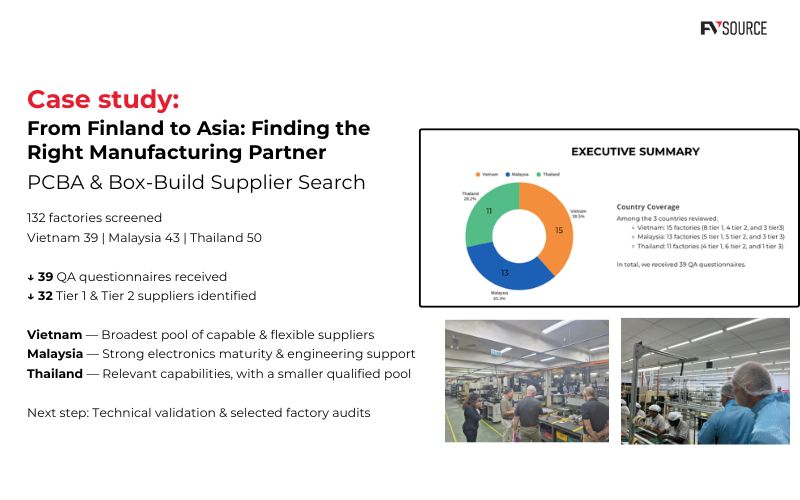
A promising supplier on paper still needs to be verified before production begins. This is where buyers move from claims and documents to evidence.
This was also a key point in ’s recent webinar on finding PCBA suppliers across Southeast Asia. An initial screening of 32 factories identified many promising candidates, but a strong profile alone was not enough to confirm their capabilities. As the experts explained: “A website can look impressive, certificates can look convincing, and a video call can go very well. But you only really understand a production partner when you look at the factory, the processes, the people, and the way they deal with problems.”
A factory visit helps buyers see how things work in practice. The goal is not simply to check whether the facility looks modern, but to determine whether its actual operations match what the supplier has presented. Buyers should look at how materials move through the facility, how production is organized, and when quality checks are carried out. Equipment maintenance, workforce organization, storage conditions, and traceability can also reveal issues that may be difficult to identify through remote assessments.
It is equally important to understand what happens outside the factory’s own walls.
Some manufacturers outsource processes such as surface treatment, heat treatment, machining, printing, or assembly. Outsourcing is not necessarily a problem, but the buyer should know which processes are handled internally and which depend on third parties.
Samples and pilot orders provide another layer of verification. A successful sample demonstrates that the supplier can produce the product under controlled conditions. A pilot order offers more insight into how the factory handles actual production, including consistency, communication, packaging, and delivery performance.
The principle is simple: do not confuse the ability to make one acceptable sample with the ability to manufacture consistently at commercial scale.
6. What to Clarify Before Starting the Partnership
Once a subcontractor has passed the technical and operational checks, commercial and contractual expectations need to be clearly established.
Price is only one part of the agreement. European buyers should also define how quality, delivery, specifications, and responsibilities will be managed throughout production.
Technical documentation should be controlled carefully. Drawings, specifications, approved samples, material requirements, testing procedures, and revision changes need to be clearly identified so that both parties are working from the same version.
Quality requirements should be measurable wherever possible. Instead of relying on broad terms such as “high quality,” the agreement can specify tolerances, inspection methods, acceptance criteria, testing requirements, and procedures for handling non-conforming products.
Intellectual property also deserves attention, particularly when the subcontractor receives proprietary drawings, tooling designs, product specifications, or other confidential information. Ownership of molds, tooling, and production-related assets should be established before production begins.
Commercial terms should cover payment conditions, lead times, minimum order quantities, shipping responsibilities, and procedures for handling delays or defective products.
Clear agreements do not eliminate every production problem. They do, however, reduce ambiguity when problems occur.
7. Common Mistakes When Choosing an Asian Manufacturing Subcontractor
Choosing a manufacturing subcontractor involves more than finding a factory that meets technical requirements. Buyers should also avoid several common mistakes that can lead to higher costs and production problems.
Choosing Primarily on Price
A low quotation may not reflect the full cost of quality issues, delays, rework, or additional inspections. Buyers should compare pricing alongside production capabilities, quality standards, and delivery reliability.
Relying Too Heavily on Samples
An approved sample does not guarantee consistent quality during mass production. Buyers should verify that the subcontractor has the processes and quality controls needed to maintain the agreed specifications at scale.
Skipping Factory Verification
Supplier profiles and certifications offer a starting point, but they may not fully reflect actual production capabilities. Factory visits or independent audits can help buyers verify equipment, production processes, and quality management in practice.
Leaving Responsibilities Unclear
Unclear expectations around specifications, inspections, delivery, and defective products can create avoidable disputes. These responsibilities should be agreed upon before production begins.
Ultimately, the goal is not to find the cheapest or largest factory, but a subcontractor whose capabilities, quality standards, and working practices match the project’s requirements.
Conclusion
Finding a manufacturing subcontractor in Asia requires more than building a list of factories and requesting quotations. The process should begin with clearly defined production requirements, followed by structured supplier screening and practical verification.
For European companies, this approach is especially important when working across different markets, languages, and manufacturing environments. A subcontractor should be evaluated not only for what it can produce, but also for how reliably it can deliver, control quality, communicate, and support the buyer’s requirements.
The strongest sourcing decisions are therefore made before the first large production order is placed. By treating supplier selection as a qualification process rather than a price comparison exercise, companies can build a manufacturing network that is better aligned with their technical and commercial needs.

