
Vietnam Market Entry Timeline Insights for International Businesses
- June 11, 2026
- Posted by: marketing
- Category: Uncategorized

When foreign executives ask how long Vietnam market entry takes, the answer they most often receive is somewhere between four and six weeks, the time it typically takes to register a company. That number is accurate, but it describes only the legal paperwork. The full Vietnam market entry process, from the first feasibility study to the first stable revenue, looks very different. For most foreign companies, the realistic timeframe runs from 12 to 18 months, and for businesses in regulated sectors or those building a direct sales team, it can stretch further. The gap between those two numbers is where plans fail, budgets run out, and investors retreat.
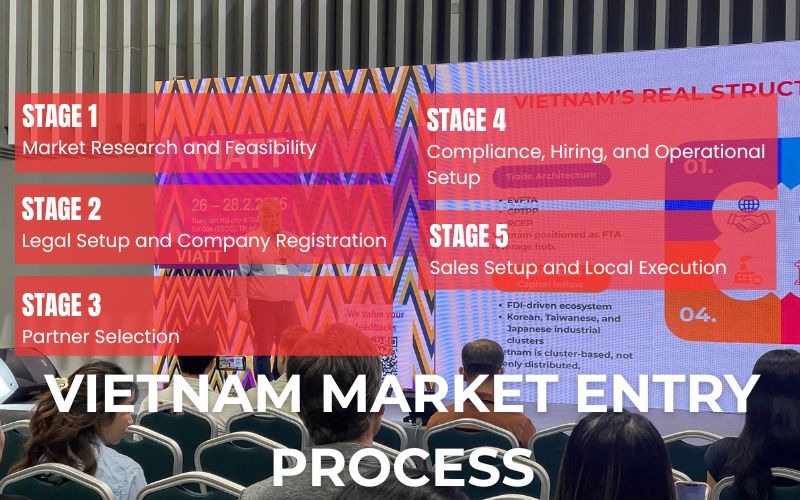
This article walks through every stage of the Vietnam market entry timeline as it actually unfolds on the ground, such as research, legal setup, partner selection, compliance, hiring, and sales execution. For foreign business owners and investors who are serious about doing business in Vietnam, understanding the full picture before committing is not just useful preparation; it is the difference between a structured entry and an expensive restart. Each stage below includes realistic timeframes, the most common sources of delay, and what a sound Vietnam market entry strategy accounts for at each step.
The Registration Myth: Why 4-6 Weeks Is Only the Beginning
One of the most common misconceptions among foreign investors is that completing company registration means they are ready to start doing business in Vietnam. In reality, obtaining legal licenses is only the first milestone in a much longer Vietnam market entry process. Many service providers promote a Vietnam business setup timeline of 4-6 weeks based on statutory registration periods. While this may be technically correct for the licensing stage, it rarely reflects the full journey from incorporation to operational readiness. For most foreign-invested enterprises, the realistic timeline is significantly longer once document legalization, banking procedures, tax registrations, hiring, supplier onboarding, and market validation are taken into account.
As of 2026, the statutory registration timeline generally includes:
- Investment Registration Certificate (IRC): approximately 15 working days for standard projects.
- Enterprise Registration Certificate (ERC): typically 3 working days after IRC approval.
- Realistic legal setup period: around 6-10 weeks when document preparation, notarization, legalization, and administrative procedures are included.
Conditional industries such as fintech, education, healthcare, pharmaceuticals, or regulated trading activities may require additional approvals, extending the timeline by several months.
The key point is that registration creates legal existence, not market readiness. A company may have an IRC and ERC, yet still lack a local team, banking infrastructure, distribution partners, compliant products, or a validated go-to-market approach. These operational elements often determine whether a market entry succeeds or fails. For foreign companies evaluating a Vietnam market entry strategy, the more relevant question is not “How fast can we register?” but rather “How long until we can generate revenue and operate sustainably?” The answer depends on supplier sourcing, regulatory compliance, talent acquisition, and commercial execution, factors that extend well beyond the registration phase. Understanding this distinction helps investors build a more realistic Vietnam market entry timeline, allocate resources effectively, and avoid costly delays after incorporation.
Stage 1: Market Research and Feasibility
The first stage of any successful Vietnam market entry process is not company registration; it is understanding whether the market can realistically support your business model. Yet this is also the stage that many foreign companies rush through or skip entirely in an effort to accelerate expansion.
A proper feasibility study goes far beyond reading industry reports. Vietnam is not a single homogeneous market. Consumer behavior, purchasing power, distribution structures, and competitive dynamics vary significantly between major cities such as Ho Chi Minh City, Hanoi, Da Nang, and secondary provinces. What works in one region may not succeed in another.
Before investing substantial resources, companies should conduct a structured assessment that includes:
- Market Research Checklist
| Market sizing and demand mapping | Identify total addressable market (TAM), serviceable market (SAM), and target customer segments.Evaluate demand differences across regions and cities. |
| Competitive landscape analysis | Map direct and indirect competitors.Benchmark pricing, positioning, and market share.Identify gaps that create competitive advantages. |
| Regulatory and compliance screening | Review foreign ownership restrictions.Assess licensing requirements and sector-specific regulations.Identify potential barriers before market entry. |
| Distribution and channel assessment | Evaluate distributors, agents, marketplaces, and direct-sales opportunities.Determine the most effective route-to-market strategy. |
- Evaluate distributors, agents, marketplaces, and direct-sales opportunities.
- Determine the most effective route-to-market strategy.
A common mistake among foreign investors is assuming that because “Vietnam is growing rapidly,” success is guaranteed. In reality, insufficient market data often leads to entering the wrong customer segment, selecting unsuitable sales channels, or launching at the wrong time. These errors can significantly increase costs and delay profitability. For this reason, market-entry specialists frequently recommend allocating a dedicated budget for feasibility research before committing to full-scale expansion. The cost of validating assumptions early is typically far lower than the cost of correcting strategic mistakes after market entry. These insights form the foundation of an effective Vietnam market entry strategy and help businesses create a realistic Vietnam market entry timeline before moving into company registration, partner sourcing, and operational setup.
Stage 2: Legal Setup and Company Registration
Once market validation is complete, the next step in the Vietnam market entry process is establishing a legal presence. This stage is often perceived as straightforward because official registration timelines appear relatively short. However, foreign investors frequently underestimate the preparation work required before submitting applications and the compliance steps that follow after incorporation.
Step 1: Prepare the Investment Dossier
Before any application is filed, investors typically need to prepare:
- Corporate documents from the parent company
- Financial statements or proof of financial capacity
- Passport and identification documents of shareholders and legal representatives
- Office lease agreement or registered business address
- Business plan and investment project description
For overseas companies, document notarization, legalization, and certified Vietnamese translation are among the most common causes of delay. In practice, this preparation phase alone can add 2–4 weeks to the overall Vietnam business setup timeline.
Step 2: Obtain the Required Licenses
Historically, foreign investors were required to obtain an Investment Registration Certificate (IRC) before applying for an Enterprise Registration Certificate (ERC). However, the new Investment Law No. 143/2025/QH15, effective from March 2026, introduces a significant change: foreign investors may establish a legal entity before completing IRC procedures, subject to implementing guidance. This reform is intended to streamline market entry and reduce administrative bottlenecks.
Common Reasons for Delays
Even when statutory timelines appear predictable, actual implementation often takes longer due to:
- Incomplete or inconsistent application documents
- Delays in the consular legalization of foreign documents
- Requests for clarification from licensing authorities
- Conditional business sectors requiring additional approvals
- Absence of the legal representative during key signing procedures
For regulated industries such as fintech, healthcare, education, pharmaceuticals, and certain trading activities, sector-specific approvals can extend the timeline by several months beyond company registration.
Stage 3: Partner Selection: The Stage That Takes Longer Than Any Other
For many foreign companies, partner selection is the most underestimated phase of the entire Vietnam market entry process, and often the primary reason market entry timelines slip by six to twelve months. While company registration follows relatively predictable procedures, identifying the right local partner requires extensive validation. A typical partner search begins with building a shortlist through business networks such as AmCham, EuroCham, industry associations, and local chambers of commerce, a process that can take two to four weeks. This is followed by initial meetings, capability assessments, and commercial due diligence, which often require an additional one to two months.
Even after selecting a promising distributor or manufacturing partner, successful companies usually conduct a pilot program before committing to a long-term relationship. Testing a limited number of products, tracking performance KPIs, and evaluating communication responsiveness can easily add another three months to the timeline. Contract negotiations covering exclusivity, territory rights, intellectual property protection, and performance obligations may then require several additional weeks.
One of the most common mistakes when doing business in Vietnam is choosing the largest distributor rather than the most suitable one. Large distributors often prioritize established brands with proven demand, leaving new market entrants with limited attention and resources. The most effective Vietnam market entry strategy treats partner selection as a long-term relationship investment rather than a procurement exercise. The right partner can accelerate growth, while the wrong one can delay expansion, increase costs, and create operational risks long after the contract is signed.
Stage 4: Compliance, Hiring, and Operational Setup
While partner negotiations are progressing, a well-planned Vietnam market entry process runs compliance and hiring in parallel, not in sequence. Companies that wait until after partner selection is finalized to begin operational setup typically add two to three months to their overall timeline unnecessarily. The key tasks in this stage are not quick, and several have fixed administrative waiting periods that cannot be shortened, regardless of how prepared the company is.
On the compliance side, the non-negotiable obligations for any Foreign Invested Enterprise (FIE) in Vietnam include VAT and Corporate Income Tax registration, opening a Direct Investment Capital Account (DICA) at a licensed bank, completing company seal registration, and, for product-based businesses, initiating product labeling and registration as required by the Ministry of Industry and Trade or the Ministry of Health. For FMCG, pharmaceutical, and food businesses, product registration alone can add one to three months to this stage and must begin well before any sales activity is planned. Annual audit obligations for FIEs under Vietnamese Accounting Standards (VAS) also need to be factored in from day one of operations, not retrospectively.
Vietnam’s labor market in 2026 offers scale but not simplicity. With a workforce of 53.3 million, the country has significant volume, but only 29.2% of workers hold a diploma or vocational certificate, meaning that finding genuinely qualified senior talent, particularly in sales leadership and regional management roles, takes longer than many foreign investors plan for. Monthly wages have risen to an average of VND 8.4 million (approximately USD 336), reflecting growing worker expectations and increasing competition for experienced staff, particularly in Ho Chi Minh City and Hanoi, where doing business in Vietnam at a professional level is concentrated. Factor realistic hiring timelines into the Vietnam business setup timeline from the outset, not as an afterthought.

Stage 5: Sales Setup and Local Execution
By this stage, most foreign companies are simultaneously finalizing their legal setup, running a distributor pilot, and building their first local team. This is where the Vietnam market entry process moves from administration into real commercial execution and where the gap between a company that planned realistically and one that did not become immediately visible. The channel model chosen at the outset now begins to determine the pace of everything that follows.
For companies using the distributor model, first sales typically begin within three to four months of a signed agreement, but stable, repeatable sell-through takes another three to six months to build, as the distributor’s sales team learns the product, educates their retail network, and works through initial feedback from end customers. For companies going direct, the pipeline-building phase tends to be longer: from first meeting to first close in a B2B context typically runs sixty to ninety days, and building a sustainable pipeline in a new market commonly takes six months or more of consistent activity. Neither path delivers instant results, and the Vietnam market entry strategy that works best is the one that allocates realistic budgets to sustain the gap between first commercial activity and breakeven.
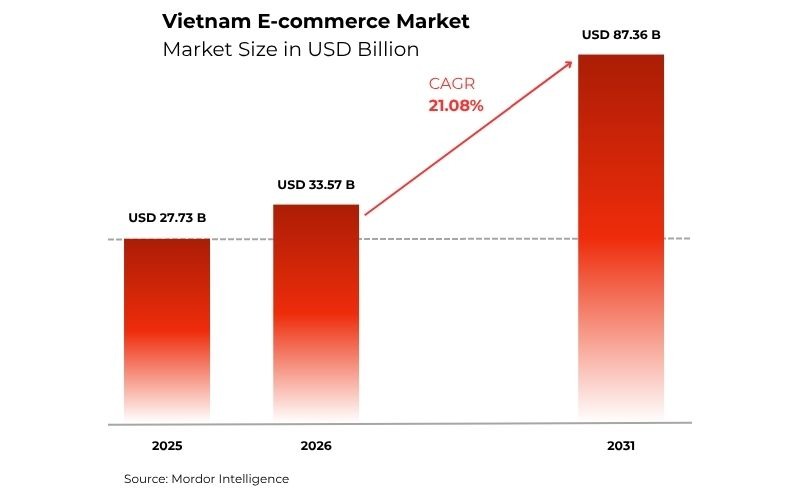
E-commerce is often positioned as the faster path. Vietnam’s e-commerce market size reached USD 33.57 billion in 2026 and is forecast to reach USD 87.36 billion by 2031, with Shopee and TikTok Shop jointly controlling 97% of platform GMV. Between May 2025 and April 2026, combined GMV across the four major platforms grew 37% year-on-year to USD 13.6 billion, with TikTok Shop posting 83% growth to USD 5.96 billion and 44% market share. A storefront on either platform can be live within thirty days. What takes considerably longer, typically three to six months of testing, content investment, and influencer activation, is building the organic traction and conversion rates that make e-commerce commercially meaningful for a new brand entering the market without an existing Vietnamese customer base.
Conclusion
Vietnam remains one of Southeast Asia’s most attractive growth markets, but successful expansion requires more than completing company registration. A realistic Vietnam market entry timeline includes market research, legal setup, partner selection, compliance, hiring, and sales execution, often spanning 12-18 months rather than a few weeks. Companies that approach the Vietnam market entry process with careful planning and local insight are far more likely to achieve sustainable growth. The right Vietnam market entry strategy is not about entering the market as quickly as possible; it is about entering with the right foundation, the right partners, and a clear path to long-term success.

