
Viettel, FPT Semiconductor, and Vietnam’s Semiconductor Ambition
- February 5, 2026
- Posted by: marketing
- Category: Manufacturing
Why Vietnam is pushing semiconductors now, and what it could mean for the country and the world
Vietnam’s semiconductor story is no longer just about hope, talent, or conference-stage ambition. It is becoming physical.
For years, Vietnam’s role in electronics was strongest in assembly, testing, export manufacturing, and the attraction of large foreign investors such as Samsung, Intel, LG, Foxconn, and Luxshare. The country built credibility as a dependable electronics manufacturing base, but semiconductors remained a more difficult frontier. Chipmaking is capital-intensive, technologically demanding, geopolitically sensitive, and structurally hard to localize. Most countries never move beyond being consumers or low-value manufacturing locations in the semiconductor value chain.
Vietnam now wants to break that pattern.
Two names increasingly sit at the center of that push: Viettel and FPT Semiconductor. They are not doing the same thing, and that difference matters. Viettel is associated with Vietnam’s attempt to build domestic fabrication capacity through the country’s first locally owned semiconductor manufacturing plant in Hòa Lạc. FPT Semiconductor, meanwhile, has positioned itself around chip design and, more recently, advanced testing and packaging capacity, while also expanding R&D and ecosystem-building efforts in places such as Hanoi and Da Nang. Together, they illustrate how Vietnam is trying to enter the semiconductor industry from multiple angles rather than relying on a single headline project.
This matters because semiconductors are not just another industrial segment. They are the control layer of the modern economy. Chips sit inside telecom infrastructure, consumer devices, cars, medical equipment, industrial automation systems, data centers, defense technologies, and AI hardware. In practical terms, a country that can only assemble finished products but cannot shape parts of the chip value chain remains dependent on external technological power. Vietnam’s semiconductor push is therefore economic, industrial, and strategic at the same time.
Introduction: Vietnam’s Semiconductor Ambition Takes Shape
A useful analogy is to think of semiconductors as the brains and nervous system of the modern industrial economy. Steel gives structure. Electricity gives power. Software gives instructions. But semiconductors are what allow machines, devices, and infrastructure to sense, compute, communicate, and respond.
That is why semiconductor capability has become a marker of industrial maturity. It is also why countries are no longer viewing chips simply as a business opportunity. They increasingly see them as a matter of resilience, sovereignty, and competitiveness. Vietnam’s ambition has to be understood in that broader global context: supply chains are being reconfigured, geopolitical risk has made overconcentration in a handful of chip locations look dangerous, and second-tier but capable countries are now trying to capture more value in the chain. Vietnam’s national strategy explicitly aims to build capabilities across design, manufacturing, packaging, and testing through 2030, with a longer-term vision to 2050.
Geographic Footprint: Where Vietnam’s Semiconductor Expansion Is Taking Place
The geography of this story is important.
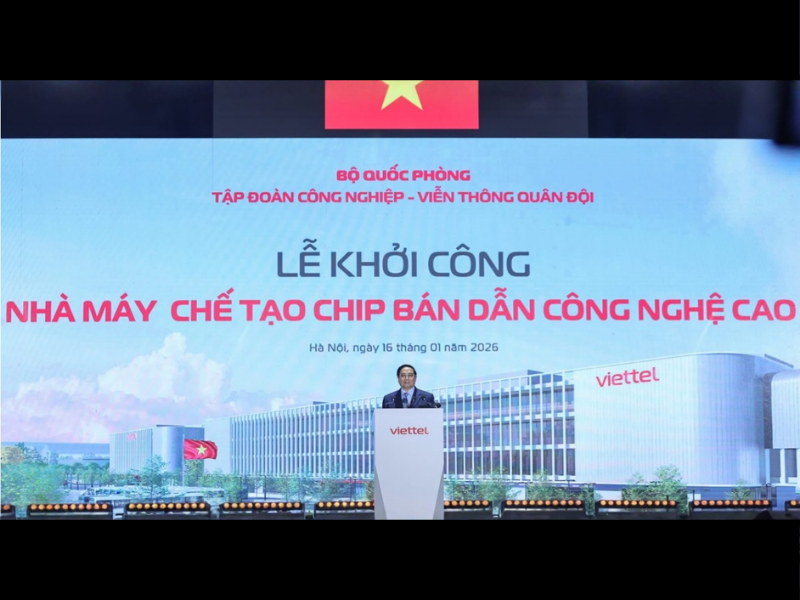
Viettel’s semiconductor manufacturing plant is being developed in Hòa Lạc High-Tech Park, on the outskirts of Hanoi. Official and reporting sources describe it as a 27-hectare site intended to function as national infrastructure for semiconductor research, design, testing, and production. It is also meant to serve industries such as aerospace, telecommunications, IoT, automotive manufacturing, medical devices, and automation. Viettel’s location choice is not accidental: Hòa Lạc is one of Vietnam’s flagship high-tech zones and is increasingly tied to the country’s ambitions in advanced industry, digital infrastructure, and innovation.
FPT Semiconductor’s footprint is more distributed. FPT Semiconductor itself was established in March 2022 as a member of FPT Corporation. Its ecosystem stretches across Hanoi, where it has worked with the National Innovation Center and partners to launch the Vietnam Semiconductor Innovation Center, and Da Nang, where it inaugurated a High-Tech and Semiconductor R&D Center in 2025. In early 2026, FPT also announced an Advanced Semiconductor Testing and Packaging Plant, presented as the first plant of its kind owned by a Vietnamese company. This places FPT more clearly in the back-end and design-to-commercialization part of the value chain rather than in leading-edge wafer fabrication.

So, in spatial and functional terms, Vietnam’s semiconductor ambition is not concentrated in one single site or one single business model. It is spreading across high-tech parks, innovation centers, R&D nodes, and industrial facilities, especially in the north and central regions.
Viettel and FPT – Key Players for the industry
To understand the significance of Viettel and FPT Semiconductor, one has to look at who they are.
Viettel: state-linked scale, telecom heritage, strategic mission
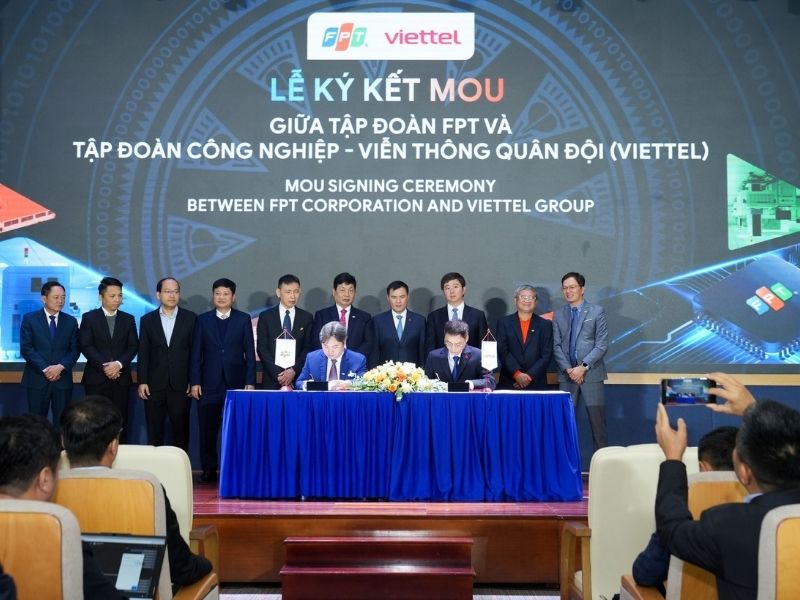
Viettel is not a startup trying to enter a glamorous sector. It is Vietnam’s military-run telecom and technology giant, with strong links to national strategy and a long record in telecommunications, digital infrastructure, defense technology, and industrial R&D. Viettel High Tech presents itself as a core research and production arm mastering end-to-end processes for both military and civilian high-tech products. That matters because semiconductors require more than entrepreneurial energy. They require patient capital, institutional protection, access to strategic customers, engineering pipelines, and the ability to absorb long development cycles. Viettel is one of the few Vietnamese organizations with the scale and political positioning to attempt something as difficult as domestic wafer fabrication.
Reporting around the Hòa Lạc plant suggests Viettel is targeting an initial 32-nanometer process node, with pilot production expected after construction and technology transfer phases. For some observers, 32nm sounds behind the frontier. But that misses the strategic point. Vietnam is not trying to leap immediately into the most advanced consumer logic chips. It is trying to establish domestic capability in commercially relevant segments that can serve telecom, industrial, defense, IoT, automotive, and specialized applications. In that sense, Viettel is not merely chasing prestige; it is building a foothold in a realistic part of the value chain.
FPT Semiconductor: design-led, ecosystem-oriented, commercially agile
FPT is a different type of actor. It comes from software, IT services, digital transformation, and technology solutions rather than from defense and telecom infrastructure. FPT Semiconductor positions itself as an IC design company that was formally established in 2022, though its VLSI-related capabilities date back earlier. The company has emphasized chip design, commercialization, training, partnerships, and application-specific chips, including IoT-related products and power management ICs. It has also promoted the “Chip Make in Vietnam – Made by FPT” narrative.
What makes FPT particularly relevant is that it appears to understand a core truth about late-entering semiconductor countries: you do not need to start with everything. You can begin where capabilities are more achievable, such as design services, niche ICs, customer-specific chips, talent development, advanced packaging, and testing. FPT’s announcement of an advanced testing and packaging plant in early 2026 is important precisely because the back-end is a more accessible and highly strategic entry point for countries trying to deepen semiconductor participation without immediately bearing the full burden of frontier wafer-fab economics.
Why the government is pushing semiconductors
Vietnam’s semiconductor push is not only corporate. It is policy-driven.
The government’s semiconductor strategy through 2030, with a vision to 2050, explicitly lays out a phased plan: attract selective FDI, build human capital, establish capability across the chain, and progressively deepen national participation in design, manufacturing, packaging, and testing. Official communications frame the industry as a strategic response to global supply-chain shifts and as an opportunity for Vietnam to move up from electronics assembly toward higher-value technology functions. The state is also pairing the industrial strategy with policies related to innovation, digital transformation, and semiconductor human-resource development.
There are several reasons the government is pushing now.
The first is economic upgrading. Vietnam already succeeded in becoming a major electronics exporter, but much of that success has been assembly-led and FDI-dominated. To capture more value, the country needs to move into knowledge-intensive and technologically sticky parts of the chain. Semiconductors represent one of the clearest pathways for that move.
The second is strategic autonomy. In a world of export controls, technology competition, and geopolitical fragmentation, countries do not want total dependence on external chip ecosystems. Viettel’s project has repeatedly been described in national terms, as infrastructure tied to high-tech autonomy and national capability. That language is not incidental. It reflects a broader understanding that technology sovereignty now has real industrial and security dimensions.
The third is a supply-chain opportunity. As global firms look for diversification beyond a few established semiconductor geographies, Vietnam sees a window to position itself as a reliable complementary node. It may not replace Taiwan, South Korea, or the United States in advanced chipmaking. But it does not need to. It can become valuable by being credible, specialized, and integrated into selected segments of the global chain.
The fourth is talent and ecosystem development. Once a country has real chip projects on the ground, engineers have somewhere to work, universities have clearer industry partners, and startups have more relevant local infrastructure. Without domestic anchors, talent often leaks abroad or into adjacent industries. With anchors like Viettel and FPT, the ecosystem becomes more tangible. FPT has publicly linked its semiconductor push to workforce training goals, and official Vietnamese sources also stress human-resource development as central to the strategy.
Implications for Vietnam
For Vietnam, the implications are potentially enormous, but they are not automatic.
The optimistic scenario is that Viettel and FPT help create a more complete national semiconductor ladder. Viettel would represent the harder manufacturing edge: fabrication, process know-how, domestic industrial infrastructure, and strategic applications. FPT would represent design capability, application-specific products, back-end services, training, ecosystem partnerships, and commercial agility. Combined with foreign-invested players already active in Vietnam, this could gradually turn the country from an electronics assembler into a more meaningful semiconductor participant.
That would have several consequences.
It could increase local value capture inside the electronics economy. Instead of importing nearly all high-value chip content and only adding labor at the assembly stage, Vietnam could begin retaining more engineering, testing, packaging, design, and eventually manufacturing value.
It could improve industrial resilience. A broader semiconductor base would support domestic industries ranging from telecom equipment and industrial electronics to automotive components, medical devices, and defense systems.
It could reshape Vietnam’s development narrative. The country is often described as a manufacturing alternative because of lower labor costs, favorable demographics, and trade agreements. A real semiconductor foothold would push it toward a different category: not just a low-cost manufacturing destination, but an emerging technology-industrial state.
But there are also limits.
Semiconductors are unforgiving. A plant announcement is not the same as a globally competitive chip industry. Vietnam still faces capability gaps in fabrication depth, equipment ecosystems, materials localization, advanced process mastery, and senior semiconductor talent. It also remains heavily dependent on foreign technology, imported equipment, and global partnerships. Even with state support, the sector will take years to mature. The more realistic question is not whether Vietnam becomes a top-tier chip superpower soon. It is whether Vietnam can become a durable and valuable mid-tier semiconductor node with strengths in selected segments.
Implications on the global supply chain
From a global perspective, Vietnam’s semiconductor push matters because the world is looking for more distributed capacity.
No serious analyst believes Vietnam will dominate cutting-edge chips in the near term. But that is not necessary for global relevance. The semiconductor industry is not one market; it is a layered system that includes design, IP, EDA, wafer fabrication, packaging, testing, equipment, materials, specialty processes, and end-use integration. New credible locations in any of these layers help diversify risk.
That is especially important at a time when semiconductor supply chains are exposed to trade conflict, strategic rivalry, tariff risk, and concentration risk. Commentary in 2025 and 2026 has already noted how tariffs and geopolitical shocks could affect Vietnam’s broader tech sector, underscoring how exposed electronics and semiconductors remain to global policy shifts. The emergence of Vietnamese domestic players does not remove that vulnerability, but it gives the country more agency within it.
For international customers, the rise of Viettel and FPT Semiconductor suggests something practical: Vietnam may become more relevant not only as a place to assemble products, but also as a place to co-develop chips, source design services, access packaging and testing, and potentially build specialized long-term supply relationships in strategic applications.
For regional supply chains, it could also reinforce Southeast Asia’s role as more than a peripheral appendage to Northeast Asia. Vietnam is part of a broader ASEAN industrial shift in which countries are trying to capture more technologically sophisticated roles rather than remaining locked into low-value manufacturing.
Conclusion
Viettel and FPT Semiconductor are not identical stories. That is exactly why they matter.
Viettel represents the state-backed, infrastructure-heavy, sovereignty-oriented side of Vietnam’s semiconductor ambition. It is about physical manufacturing, national capability, and the willingness to enter the hardest part of the chain from a realistic industrial starting point.
FPT Semiconductor represents the commercially agile, design-led, ecosystem-building side. It is about talent, R&D, application-specific chips, testing and packaging, partnerships, and creating a more navigable entry path for Vietnam into the semiconductor economy.
Together, they suggest that Vietnam is no longer content to remain only an assembly platform in the electronics era. It wants to move closer to the technological core.
Whether that ambition succeeds will depend on execution, patience, talent development, international collaboration, and the ability to avoid mistaking announcements for capability. But the direction is now clear. Vietnam is trying to build a semiconductor future with domestic anchors, and the emergence of Viettel and FPT Semiconductor is one of the clearest signs yet that this shift is becoming real.

